

Quick Answer
“Very full” is one phrase doing five different jobs. A glass can be full. A train can be full. A diner who cannot manage one more bite is full — and a report or a singer’s voice can be full without holding anything at all. Each idea owns its own vocabulary, and borrowing across the fence is how sentences go wrong: a suitcase is never “stuffed” in careful writing, and a stomach is never “crammed.”
So this guide splits “very full” into its five real senses and ladders each one separately. Even the Merriam-Webster thesaurus entry for “full” lists more than 500 relatives side by side without grading their strength or separating their senses — the grading and the separating are exactly what this guide adds.
If you mean a container or a space:
- Filled — the plain, neutral word: it holds as much as it should.
- Brimming — filled right up to the rim, nothing spilled yet.
- Packed — things pressed in with no gaps left.
- Overflowing — past full; more than the container can hold.
If you mean people and places:
- Packed — the default crowd word; every seat and space taken.
- Jammed — crowded and stuck; nothing can move.
- Teeming — full of living, moving people or creatures.
If you mean you have eaten enough:
- Full up — the plain informal way to say it.
- Stuffed — the everyday strong word; not one bite more.
- Satiated — the formal word: completely satisfied.
If you mean complete, with nothing missing:
- Complete — whole, with every part present.
- Comprehensive — covering everything; for reports and accounts.
- Thorough — deep and detailed, leaving nothing unexamined.
If you mean sound or flavor:
- Full-bodied — rich and strong, of wine, coffee, and voices.
- Resonant — a voice that fills a room and carries.
- Rounded — full and smooth, with no thin edges.

The Container Ladder: From Half-Empty to Overflowing
Before the senses split, here is the master ladder for the oldest meaning of full — a container that can hold no more. Read it top to bottom: each rung holds a little more than the one above it, and the last rung holds more than it should.
| Word | How full? | Best for |
|---|---|---|
| Half-full | About 50% — the optimist’s reading | Glasses, tanks, stadiums in sports reports |
| Filled | Full as intended; the plain fact | Bottles, forms (a different sense), schedules |
| Full to the brim | Exactly at the rim, surface level | Glasses, cups, buckets |
| Brimming | At the rim and seeming ready to spill | Cups of tea, eyes with tears, confidence |
| Chock-full | Completely full, no corner empty | Boxes, shelves, schedules, old houses |
| Jam-packed | Full and pressed tight | Suitcases, stadiums, calendars |
| Overflowing | Past capacity — spilling over | Sinks, inboxes, crowds, gratitude |
| Bursting at the seams | So full it may break open | Suitcases, closets, growing towns |
Notice the ladder’s honest top: the answer to “what is more than full?” is overflowing.
Synonyms for Very Full Containers and Spaces
Filled — the plain, neutral word
Filled is the working word of the family: it simply reports that something now holds what it was meant to hold. A filled bottle, a filled seat, a filled position at work. It carries no drama in either direction, which makes it the safest choice in formal writing.
- “Keep the tank filled above the halfway line all winter.”
- “By nine o’clock, every seat in the hall was filled.”
- “She handed back the filled form at the front desk.”
Brimming and brimful — full to the very rim
Brimming describes the moment just before spilling: the liquid sits level with the rim, and one more drop would go over. Because it catches that exact instant, it also works beautifully for feelings that are about to spill — eyes brimming with tears, a speaker brimming with confidence. Its partner brimful means the same thing and is the “fancy word for full” that trivia questions love; it sounds slightly old-fashioned, which is part of its charm.
- “He set down a mug brimming with hot cider.”
- “The lake sat brimful after a week of rain.”
- “She came off the stage brimming with energy.”
Packed — pressed in, no gaps
Packed says the contents were pushed together until the empty spaces disappeared. A packed suitcase has clothes rolled and pressed into every corner; a packed box leaves no room for the contents to rattle. It is stronger than filled because it describes effort: someone, or something, made it fit.
- “The trunk was packed with blankets, tools, and two spare tires.”
- “He lifted a packed backpack onto the scale — nineteen kilos.”
- “Her closet is packed; nothing new goes in until something comes out.”
Crammed — forced into too little space
Crammed adds a complaint to packed: the space was really too small for what went into it. Books crammed onto a shelf lean and bulge. Papers crammed into a drawer stop it from closing. Use crammed when the fullness feels like a squeeze, not a success — that built-in discomfort is exactly what separates it from its neighbors, and why it sounds wrong for happy occasions.
- “Forty folders were crammed into a cabinet built for twenty.”
- “He crammed one more sweater into the drawer and pushed it shut.”
- “The attic is crammed with boxes nobody has opened in years.”

Chock-full — completely full, and cheerfully so
Chock-full is the most good-natured word on the ladder: completely full, every corner occupied, said with a smile. A chock-full pantry, a chock-full notebook, a weekend chock-full of plans. It is informal, so keep it out of legal or technical writing, but in everyday prose nothing beats it.
- “The old house was chock-full of furniture, paintings, and forty years of letters.”
- “Her notebook is chock-full of recipes clipped from magazines.”
- “We have a chock-full schedule on Saturday, so let’s meet Sunday.”
Jam-packed — packed, and then some
Jam-packed pushes packed one step further: full, pressed, and sealed by pressure. It is the word for stadiums on final day and suitcases sat on to close. Like chock-full it is informal, but where chock-full smiles, jam-packed strains — pick by the mood of the sentence.
- “The night train was jam-packed; passengers stood the whole six hours.”
- “His calendar is jam-packed until the end of the quarter.”
- “The storage unit is jam-packed from floor to ceiling.”
Overflowing — more than full
Overflowing is the top of the ladder: the contents have passed the limit and are escaping. And because the picture is so clear, English borrows it constantly for good things that will not stay contained — an overflowing inbox (less good), a heart overflowing with gratitude (very good). If a reader asks what is more than full, this is the word.
- “The river, overflowing its banks, closed the low road for two days.”
- “Donations poured in until the collection boxes were overflowing.”
- “She thanked the neighbors with a heart overflowing with gratitude.”
Bursting — the dramatic top rung
Bursting, usually in the phrase bursting at the seams, describes fullness that is about to break its container: a suitcase whose zipper strains, a town bursting with new arrivals, a closet bursting at the seams.
- “One more book and that shelf will be bursting.”
- “The little theater was bursting at the seams on opening night.”
- “He dragged in a suitcase bursting with souvenirs.”
One fence before we leave containers: a sponge or a field is not “full” of water in this ladder’s sense — it is saturated, soaked through rather than filled up. That whole wet family, from damp to drenched, is taught in our guide to synonyms for very wet.
Synonyms for Very Full Places: Crowds
People fill places differently from water in a glass, and three of these words belong only to the living.
Packed and crowded — the everyday pair
Packed is the default: a packed restaurant, a packed bus, a packed dance floor — every seat taken and the standing room gone. Crowded is milder and more neutral; a crowded market is busy and full of people, but you can still move through it. If the crowd delighted you, reach for packed; if it merely surrounded you, crowded is honest.
- “The café was packed by eight, with a line at the door.”
- “We left the crowded platform and waited for the next train.”
- “A packed stadium sang the anthem together.”

Jammed — crowded and stuck
Jammed adds the missing ingredient: nothing can move. A jammed highway, a jammed doorway, a jammed elevator lobby at rush hour. It belongs to crowds and traffic that have stopped flowing.
- “The exit was jammed with fans all leaving at once.”
- “Downtown stayed jammed until well after midnight.”
- “A jammed switchboard kept callers waiting for an hour.”
Teeming and swarming — full of living motion
Here is the fence this pair needs: teeming and swarming describe living, moving fullness — a harbor teeming with boats and fishermen, a garden teeming with bees, a square swarming with tourists. They cannot describe boxes, bottles, or books, because their whole meaning is movement and life. Swarming leans toward insects and slight unease; teeming is the grander, often admiring word.
- “The tide pools were teeming with crabs and tiny fish.”
- “By noon the old town was swarming with visitors.”
- “His notebook teems with ideas” — said of a mind, never of the paper alone.
Synonyms for “I’m Full”: Eaten Enough
Search engines see “I’m full synonym” and “full synonym food” every day, because this is the full people say out loud most. Its ladder is short but its register range is wide — from playground slang to words that belong in novels.
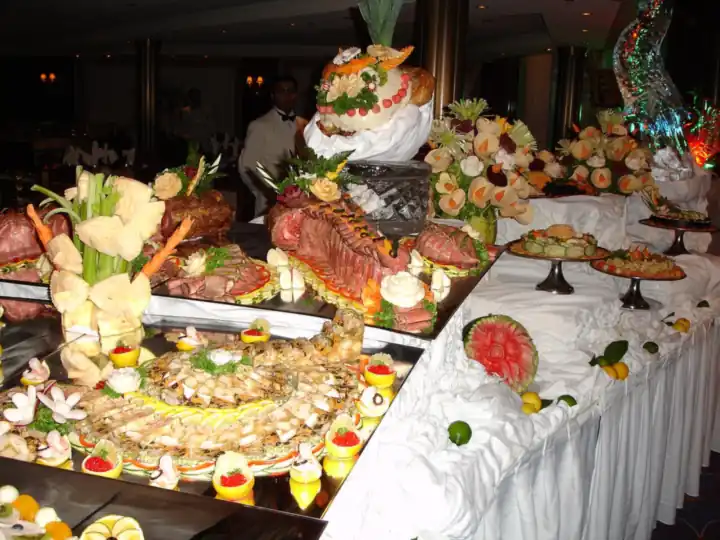
Full up and stuffed — the everyday words
Full up is the plain informal phrase: “No more for me, I’m full up.” Stuffed is its stronger everyday partner and the closest thing English has to a slang word for this sense — “I am absolutely stuffed.” Stuffed also moonlights for objects that are filled with soft material (a stuffed chair, a stuffed toy), which is exactly why careful writers do not use it for suitcases: luggage is packed, dinner guests are stuffed.
- “One helping of that stew and I was full up.”
- “After the third course, Marcus leaned back: ‘I’m stuffed.'”
- “The kids came home stuffed from their grandmother’s cooking.”
Satisfied and satiated — the satisfied end
Satisfied is the polite word: it thanks the cook while closing the meal — “Thank you, I’m satisfied” says the food was enough and good. Satiated is its formal cousin, the word of essays and older novels: completely satisfied, wanting nothing more. It is precise and slightly stiff — excellent in formal writing, faintly comic at a family barbecue.
- “She set down her fork, satisfied, and asked for tea.”
- “The guests rose from the table satiated and slow.”
- “A satiated reader closes the book happy” — the word borrows well for appetites of every kind.
Replete — the fancy word, fenced
Replete means filled to satisfaction and beyond, and it is the correct answer to “what is a fancy word for full?” — with a warning label. It belongs to formal and literary English. A report can be replete with examples (where it crosses into the completeness sense below), but announcing “I am replete” at a cookout will get you teased.
- “His memoir is replete with small, perfect details.”
- “They left the banquet replete and content.”
- “The report was replete with charts nobody read.”
Bloated — full, and sorry about it
Bloated describes fullness that has turned unpleasant: swollen, heavy, uncomfortable. It is a complaint, never a compliment — telling a host you feel bloated comments on your stomach, not their cooking, but it still lands badly at the table. Outside the body it keeps the same sour flavor: a bloated budget, a bloated bureaucracy — things swollen past their proper size.
- “After the long flight and two airport meals, he felt bloated and tired.”
- “The committee called the proposal a bloated budget.”
Synonyms for Very Full Meaning Complete
Sometimes “full” has nothing to do with capacity. A full report, a full refund, a full schedule, the full moon — here full means whole, entire, with nothing missing. The vocabulary changes completely.

Complete and entire — nothing missing
Complete is the captain of this sense: a complete set, a complete sentence, the complete works of an author — every part present. Entire stresses wholeness as one undivided piece: the entire town, her entire life, read the entire letter in one sitting.
- “The box held a complete set of chess pieces.”
- “He spent the entire summer restoring the boat.”
- “Give me the complete list, not the summary.”
Total — complete in amount or degree
Total measures the whole amount: the total cost, total silence, a total stranger. Choose it when the fullness can be counted or summed — total darkness is darkness with nothing missing.
- “The total bill came as a surprise.”
- “A moment of total quiet settled over the lake.”
- “The machine ground to a total stop.”
Comprehensive and thorough — full of detail
A full account of an event is one that leaves nothing out, and its two precision words split by shape. Comprehensive means covering everything: a comprehensive guide, a comprehensive review of the evidence. Thorough means deep as well as wide: a thorough search checks every drawer twice. A full report wants to be comprehensive; a full investigation wants to be thorough.
- “The newspaper printed a comprehensive account of the trial.”
- “Her thorough notes saved the project twice.”
- “Ask for a comprehensive quote before you sign anything.”
Full Sound and Full Flavor
The last sense fills ears and mouths instead of containers. A full voice and a full flavor are rich, deep, and satisfying — and their words overlap with the vocabulary of abundance taught in our guide to synonyms for very rich, where rich food means depth of flavor, not depth of pocket.
Full-bodied, resonant, rounded
Full-bodied is the tasting-note word: a full-bodied wine or coffee has weight and presence from the first sip to the last, and the same phrase praises a full-bodied voice in a choir. Resonant belongs to sound that fills space — a resonant hall, a resonant baritone that you feel in the floorboards. Rounded describes fullness smoothed at the edges: a rounded tone, a rounded flavor, nothing thin or sharp sticking out.
- “The choir’s full-bodied sound filled the stone church.”
- “His resonant voice carried to the last row without a microphone.”
- “A rounded, mellow flavor — the opposite of thin and watery.”
One fence matters here: full is not the same as loud. A whisper can be rich and a shout can be thin. When the only thing you mean is volume, the words live in our guide to synonyms for very loud; when you mean depth and body, stay with this family.
A Figurative Fence: “Full of Himself”
One common phrase must be fenced off from every ladder above: to say someone is full of himself (or herself) is to call them conceited — swollen with self-importance. It is never a compliment, and none of this article’s synonyms can replace it; the vocabulary for that fault, from proud through arrogant to pompous, is graded in our guide to synonyms for very proud. The honest one-word answer to “what do you call a person who is too full of themselves?” is conceited — and the thought belongs to pride, not to containers.
Full vs. Its Neighbors
Full vs. filled. Full describes a state; filled describes the result of an action. The glass is full because someone filled it. That is why we say “a filled form” (someone filled it in) but “a full glass” (its state now).
Full vs. packed vs. crammed. These three are the ladder in miniature. Full is the plain fact — the bus is full. Packed adds pressure and effort — every space used, nothing wasted. Crammed adds discomfort — too much went into too little room. A hotel can be proudly full, a suitcase satisfyingly packed, but almost nothing is happily crammed.
Full vs. complete. A box of puzzle pieces can be full (it holds a lot) without being complete (one piece is missing), and a short report can be complete (nothing needed is missing) without being long. Capacity is full‘s question; wholeness is complete‘s.
Antonyms: The Opposite of Very Full
Every sense of full has its own empty:
- Empty — the master opposite, for containers, rooms, and stomachs alike: an empty bottle, an empty theater, an empty feeling.
- Vacant — empty and available, of seats, rooms, and jobs: “a vacant seat by the window,” “the apartment stood vacant for months.”
- Hollow — empty inside, of containers and sounds: a hollow log, a hollow victory (full in name, empty in fact).
- Hungry — the eaten sense reversed: the stomach that full up left behind.
- Half-empty — the pessimist’s twin of the ladder’s first rung: the same glass, read downward.
- Incomplete — the completeness sense reversed: an incomplete set, an incomplete account.
One scarcity fence: when empty describes a purse, a pantry, or a bank account, the sentence has wandered from containers into having too little — and that vocabulary, graded from short on money to destitute, belongs to our guide to synonyms for very poor.
Common Mistakes with “Very Full” Synonyms
Mistake 1: Calling luggage “stuffed” in formal writing. Stuffed belongs to stomachs and soft toys. In a report or a careful email, a suitcase is packed, crammed, or filled — “passengers stuffed their bags” will read as careless even though everyone understands it.
Mistake 2: Calling a happy crowd “crammed.” Crammed complains. Festival-goers in a crammed square sound trapped; the same crowd in a packed square sounds like the place to be. Save crammed for the commute, not the celebration.
Mistake 3: Announcing that you are “replete.” Replete is a written, formal word. At the table, say full up, stuffed, or satisfied — “I’m replete” sounds like a butler in a play, and your host will hear stiffness instead of thanks.
Mistake 4: Grading fullness with “fuller” and “most full.” Here is the honest rule: fuller is a real word and English uses it gladly where fullness genuinely comes in degrees — the fuller moon, a fuller figure, a fuller flavor, a fuller account of the story. But a container does not get “fuller” in careful writing once it reaches the rim; it is full, then it overflows. Write “completely full,” not “very most full,” and never “fuller cup” when you mean one filled closer to the brim — say exactly that.
Mistake 5: Offering “bloated” as praise. Bloated means swollen past comfort. A guest who says the meal left them bloated has described a stomach problem, not a compliment, and a “bloated” menu or budget is an insult in print. The praise words are satisfied, satiated, and plain stuffed.
Mistake 6: Teeming with objects. “The shelf was teeming with books” borrows a living word for dead things. Shelves are packed or crammed; harbors, markets, and minds teem, because something in them moves.
FAQ
What is another word for “very full”?
It depends on the sense — that is the whole lesson of this guide. For a container: brimming, packed, or chock-full. For a place with people: packed or jammed. After a meal: stuffed or full up. For something complete: complete or comprehensive. Pick the sense first and the word chooses itself.
What is a fancy word for “full”?
Replete and brimful. Replete is the formal word for filled completely — a speech replete with quotations, guests replete after a banquet. Brimful means full to the rim and carries a pleasant, slightly old-fashioned glow: a brimful cup, a brimful day of events.
What is another word for “overly full”?
Overflowing for containers, crammed or bursting for things pressed past their limit, and bloated for a person who ate past comfort. Each one says “too much” in a different direction — spilling, straining, or swelling — so choose the picture that matches.
What is more than full?
Overflowing. Full is the ceiling of the ladder: once the contents pass it, they spill, and English switches from the fullness words to the overflow words. A cup at the rim is brimming; a cup past the rim is overflowing onto the saucer.
What is a slang word for “full”?
For the eaten sense, stuffed — “I’m stuffed” is the everyday, informal way to refuse dessert. British English also has chocka (from chock-full) for anything completely full, but it is British slang; American readers may not know it, so in American writing stuffed and jam-packed do the job.
What word means feeling full after eating?
Satiated — completely satisfied, wanting nothing more. Its matching noun is satiety: “satiety” is the full, finished feeling itself, the word nutrition writers use when fullness sounds too plain. At an ordinary table, though, full up and stuffed are what people actually say.
What is a synonym for “completely full”?
For containers, chock-full and brimful. For crowds, jam-packed. For things that are whole rather than filled, complete and entire. “Completely full” is also perfectly good English — sometimes the intensifier is the honest choice, and the ladder is for the sentences where it is not.
The Short Version
“Very full” is five phrases wearing one coat. For containers, climb the ladder — filled, brimming, packed, chock-full — and stop at overflowing, because that is what “more than full” is called. For crowds, reach for packed or jammed, and keep teeming for things that move. For a finished meal, stuffed is the everyday word, satiated the formal one, and bloated the complaint. For completeness, say complete, comprehensive, or thorough; for sound and flavor, full-bodied and resonant. Sense first, rung second, register third: that order will never steer you wrong.

SynonymsKey helps students and writers find the right word, with synonyms grouped by meaning, antonyms, and clear examples for everyday writing.